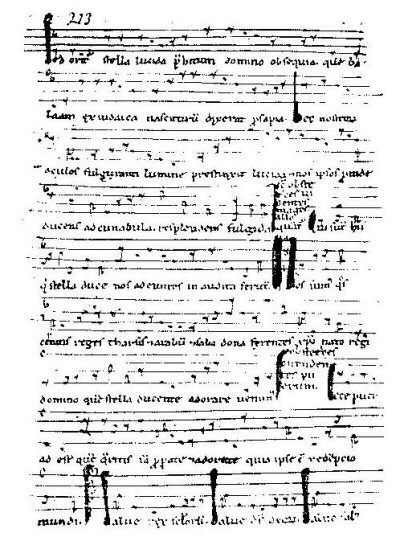
The manuscript known as the Fleury Playbook occupies pages
176-243 in a composite volume of sermons, biblical texts, liturgical
dramas, and hymns now in the Municipal Library of Orléans in central France
as MS 201. This collection of ten religious plays is named after the
Roman town of Fleury—nowadays known as St Benoît-sur-Loire—where it
was kept at the Abbey of St Benoît
(Benedict) until the dispersal of much of the monastic library during
the anticlerical aftermath of the French Revolution.
All the plays are set to music in a style recalling the unaccompanied
plainsong of the liturgy from which these plays undoubtedly evolved.
The plays were probably performed in the church by the clergy and choir—unlike
the cycles of "miracle"
plays, presented outside in the vernacular. It is generally agreed that the manuscript
was compiled in about 1200, around the time when the Abbey of St Benoît-de-Fleury
(as it now likes to be known) was being extended into its present form by linking
the nave of the earlier monastic church of St Mary with the massive independent
tower-porch (dating from c 1050) at its west end. The Playbook is a unique source
of a repertoire that is sometimes called "medieval opera."
The Atlanta Camerata production combines portions of two of the plays, The
Play of Herod and The Slaying of the Innocents. The score was prepared by Noah Greenberg in 1963 for the New York Pro Musica and has been edited by Kevin Culver. The projected images are 19th-century lithographs of the 12th-century West windows of Chartres Cathedral.